
Ken Wagner, Ph.D, Water Resource Services, Inc. Review
Ken Wagner, Ph.D, is a Certified Subject Matter Expert for NALMS (North American Lake Management Society). His areas of expertise include In-lake management techniques for algae & rooted plants, Limnology, and Lake Management.
We reached out to him for an overview of his experiences with the Lake Bottom Blanket. He was very kind to take time out of his busy schedule, and wrote the following:
Ken Wagner during an installation of Lake Bottom Blankets
Experience with Lake Bottom Blanket (LBB)
Ken Wagner, Ph.D., Certified Lake Manager
Water Resource Services, Wilbraham, MA, kjwagner@charter.net

I have been using LBB in projects for about a decade now, having previously worked with a number of porous and non-porous benthic barriers. My favorite had been Aquascreen and its variants, which looked like heavy duty, nylon window screen, was porous, and very durable. However, many plants were able to root through it, and permeability was not always high; bacteria and fine particles clogged the pores readily. I was looking for a substitute and found LBB at a conference of the North American Lake Management Society. In discussion with the exhibitors, I expressed reservations about its strength, durability, ability to vent gases, and details of application. Most of my concerns proved to be unfounded, and LBB has performed admirably in multiple projects since then.
Here are some of the findings:
- The material is very thin and light, yet remarkably strong; it can be cut but not torn by hand. Sheets are typically 10 feet wide, a manageable width for most applications. The sewn in sleeves for rebar every five feet make it possible to weigh the sheet down without having exposed metal or anything tied to the barrier. The punched holes vent gas nicely and have not resulted in much plant growth through them. LBB is light colored on one side and dark on the other, providing options for how visible the barrier will be under different conditions. Fishing lures can snag on the material, but it is more likely that the line will snap before the barrier can be moved.
- LBB is best applied when folded in an accordion fashion, allowing the barrier to be laid out from a boat moving slowly along the direction the barrier is to lay on the bottom. For really flat coverage or slight adjustment of position, it is fairly easy for two people to swim along and pull on the rebar in the sleeves from each side. Laying multiple sheets side by side can be a challenge, as one normally wants the sheets to have a few inches of overlap to prevent plant growth in between, and getting those sheets to line up without going into the water is difficult. Applying sheets longer than 50 feet can be a challenge as well, but we have put in sheets as long as 100 feet.
- Control of plant growth has been virtually complete. Some plants may grow out from under the barrier at its edge, but growth under LBB has been negligible. Contact with LBB may seem unnatural or undesirable to those wading in shallow water, in which case LBB can be applied in the spring and removed at the start of the contact use season, usually in early June in southern New England and the mid-Atlantic states. Plant control has been adequate through summer in most cases with temporary spring application. Where the water is deep enough that people cannot walk on it, LBB can be left for at least two years in most cases with minimal maintenance.
- Lake Bottom Blanket will vent gas very nicely, but if whole chunks of bottom sediment float up due to gas accumulation, the floating sediment mass may lift the LBB. One application in a very mucky pond on Cape Cod resulted in such billowing. Removal of the floating sediment mass was not easy but did allow the barrier to settle back into place. No billowing of LBB has been observed over sandy sediment, the normal substrate in swimming areas. Installation of LBB around boat docks has minimized plant growth and associated prop fouling. Laying long panels of LBB, or several shorter panels laid end to end, can create channels through dense plant growths to allow boats or swimmers to reach open water. Those channels also enhance habitat, increasing ecological edge effects and providing hunting grounds for fish and waterbirds.
After much longer than two years, sediment and debris that accumulates on top of the barrier may necessitate cleaning. Just pulling the barrier up is often enough to clean it, but we have laid it on a beach or lawn and hosed it down or pressure washed it in some cases. One could flip smaller lengths of LBB in place in shallow water, avoiding complete removal and any lapse in coverage. Removal is initiated by pulling up one end of the barrier; LBB comes with a rope loop at each end and optional floats that can indicate LBB location. We find that the buoys are not usually needed and may interfere with swimming or boating, but the associated rope provides an easy means to start the removal process if someone can use a mask and snorkel to find it. LBB can be stacked on a boat in that accordion configuration as it is removed. Pulling up LBB if much sediment has accumulated can require some effort, but only rarely has anyone had to dive down and scoop sediment off LBB to support removal.
The original barrier purchased for use 10 years ago for one Massachusetts lake is still in use. It is discolored in areas but still quite functional. Some of the plastic ties that hold rebar in place have required replacement, but no barrier has had to be retired. The cost per unit area is not high, but the cost will add up quickly if larger areas are to be covered. Yet with an apparent useful lifespan of >10 years, the long-term cost is favorable compared to most other plant control options. I have never been involved in the installation of more than 2 acres of any benthic barrier in any one lake, and most environmental regulatory agencies will not want a large percentage of lake area covered to avoid potential habitat loss. Yet for control of plants over a small area, typically a swim area or around access points like docks or boat launches, LBB is a very useful product.
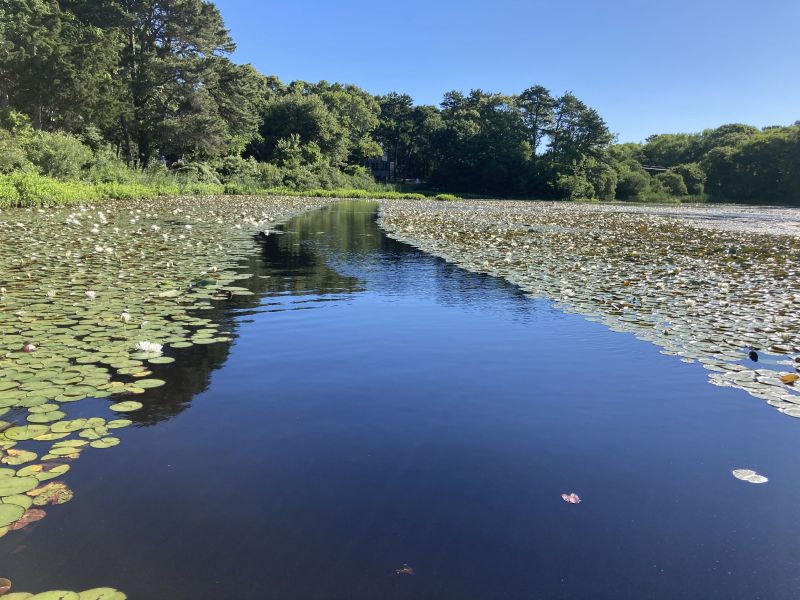
Lake Elizabeth in Centerville, MA after the Red Lily Project Association installed many LBBs for a clear pathway to other parts of the lake under the guidance of Ken Wagner, Ph.D.